Climate Risk and Rising Insurance Premiums Drive New Foreclosure Pressures
August 25, 2025
Mitchell-Lama 2.0: Affordable New York Homeownership Amidst Audit Findings & Mayoral Elections
August 26, 2025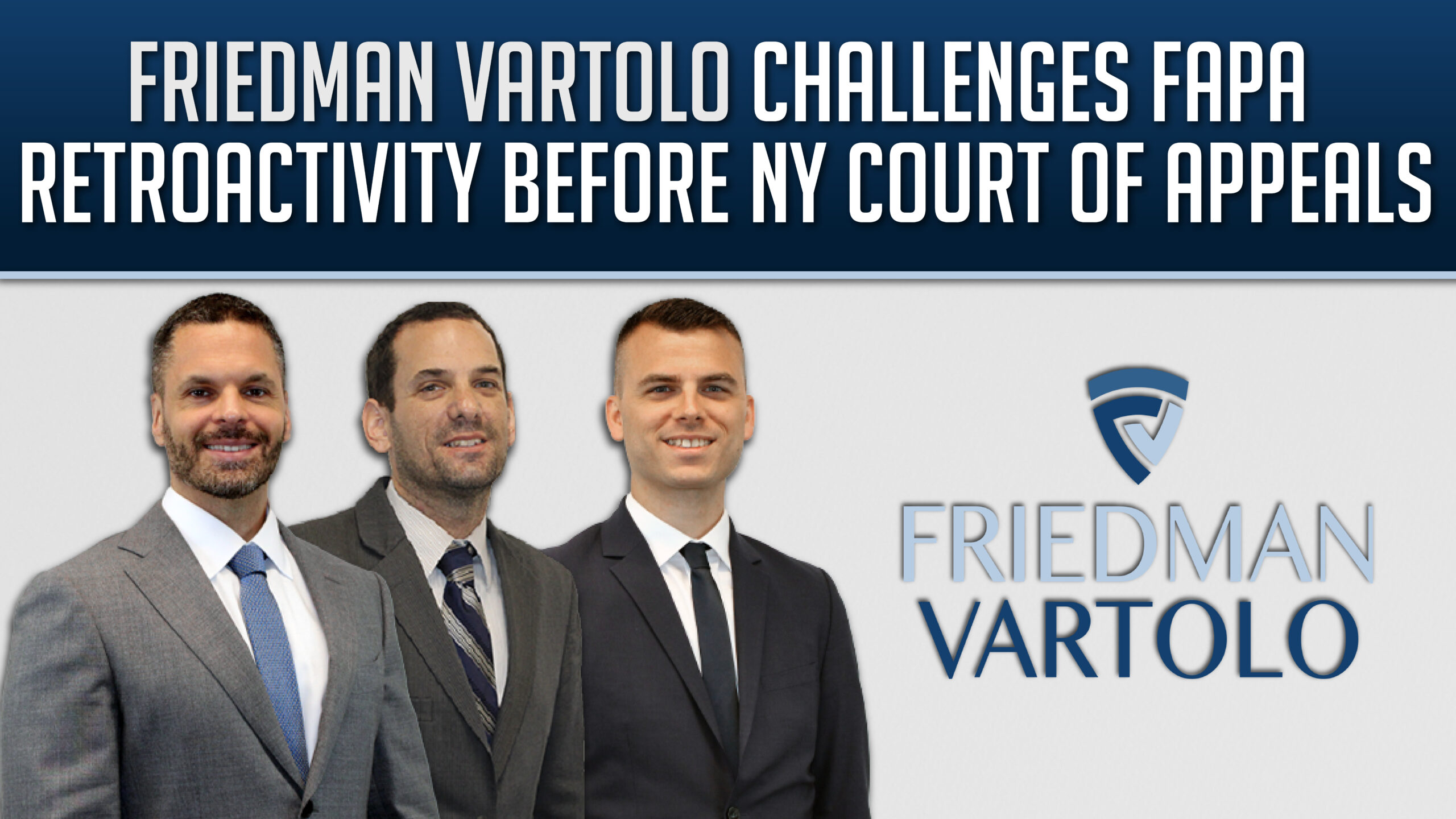
August 25, 2025
On August 22, 2025, Friedman Vartolo LLP (“FV”), on behalf of the American Legal & Financial Network (“ALFN”), filed an amicus curiae brief in support of the appellant mortgagee in Article 13 LLC v. Ponce de Leon Federal Bank, 43 N.Y. 3d 982 (2025), urging the New York Court of Appeals to hold that the Foreclosure Abuse Prevention Act (“FAPA”) applies only to foreclosure actions filed after its December 30, 2022 effective date. FV on behalf of ALFN further argued that any retroactive application of FAPA to foreclosures filed before its enactment date would violate the Due Process Clause of the New York State Constitution, Article I, §6.
The case stems from certified questions by the Second Circuit, asking whether:
1. The statutory text of the FAPA ¶10 sufficiently indicates the Legislature’s intent for the amendments to apply retroactively to foreclosures commenced before December 30, 2022, and
2. If so, whether such retroactive application violates the Due Process Clause of the New York Constitution.
FV’s brief on behalf of the nation’s largest mortgage default trade association answers these questions by arguing that FAPA should not apply retroactively and that doing so would violate due process. The ruling could impact thousands of mortgage enforcement cases and reshape foreclosure law across New York.
Case Background
The dispute arose after a federal district court applied FAPA retroactively to cancel a mortgage as time-barred. Relying on FAPA and the newly enacted CPLR § 213(4)(b), the district court barred mortgagee from arguing that the six-year statute of limitations had not run, because the 2007 acceleration was conducted by an entity without standing. In doing so, the court effectively condoned a complete stranger’s ability to exercise dispositive rights under a mortgage contract. On appeal, the Second Circuit then certified the above questions to the Court of Appeals for resolution. FV’s brief on behalf of ALFN emphasizes that FAPA contains no express retroactivity language, that New York law presumes statutes apply prospectively, and that indefinite retroactivity undermines vested property rights.
Market Impact
Indefinite retroactive application has already disrupted investor confidence, devalued New York mortgage portfolios, and chilled participation in the secondary market. These effects ripple outward — constraining liquidity, altering pricing models, and deterring lenders and investors from operating in New York. If upheld, retroactive application could lock in these market distortions, constrict credit availability, increase borrowing costs, and drive capital to other jurisdictions with more predictable legal frameworks.
The Court’s decision will determine whether FAPA functions as a forward-looking procedural reform or becomes a retroactive measure that upends settled legal rights, with lasting consequences for New York’s position in the national mortgage market.
DISCLAIMER
This publication may constitute attorney advertising under the laws and rules of professional conduct of one or more states. The information provided in this publication is for general informational purposes only and does not constitute legal advice. The contents are not intended to be a substitute for professional legal advice, consultation, or representation. No attorney-client relationship is formed by reading or relying on this publication. Prior results do not guarantee a similar outcome. Readers should consult a qualified attorney for advice regarding their individual circumstances or any specific legal questions they may have.
If you have questions about this publication, please contact Adam Friedman, Ralph Vartolo or Michael DeRosa,
Friedman Vartolo LLP, 1325 Franklin Avenue, Suite 160, Garden City, NY 11530, Phone: (212) 471-5100 | Fax: (212) 471-5150.