Fannie Mae’s DU 12.0 Updates on Credit Score Requirements
November 7, 2025
Illinois Adopts New Receivership Act Takes Effect in January 2026
November 12, 2025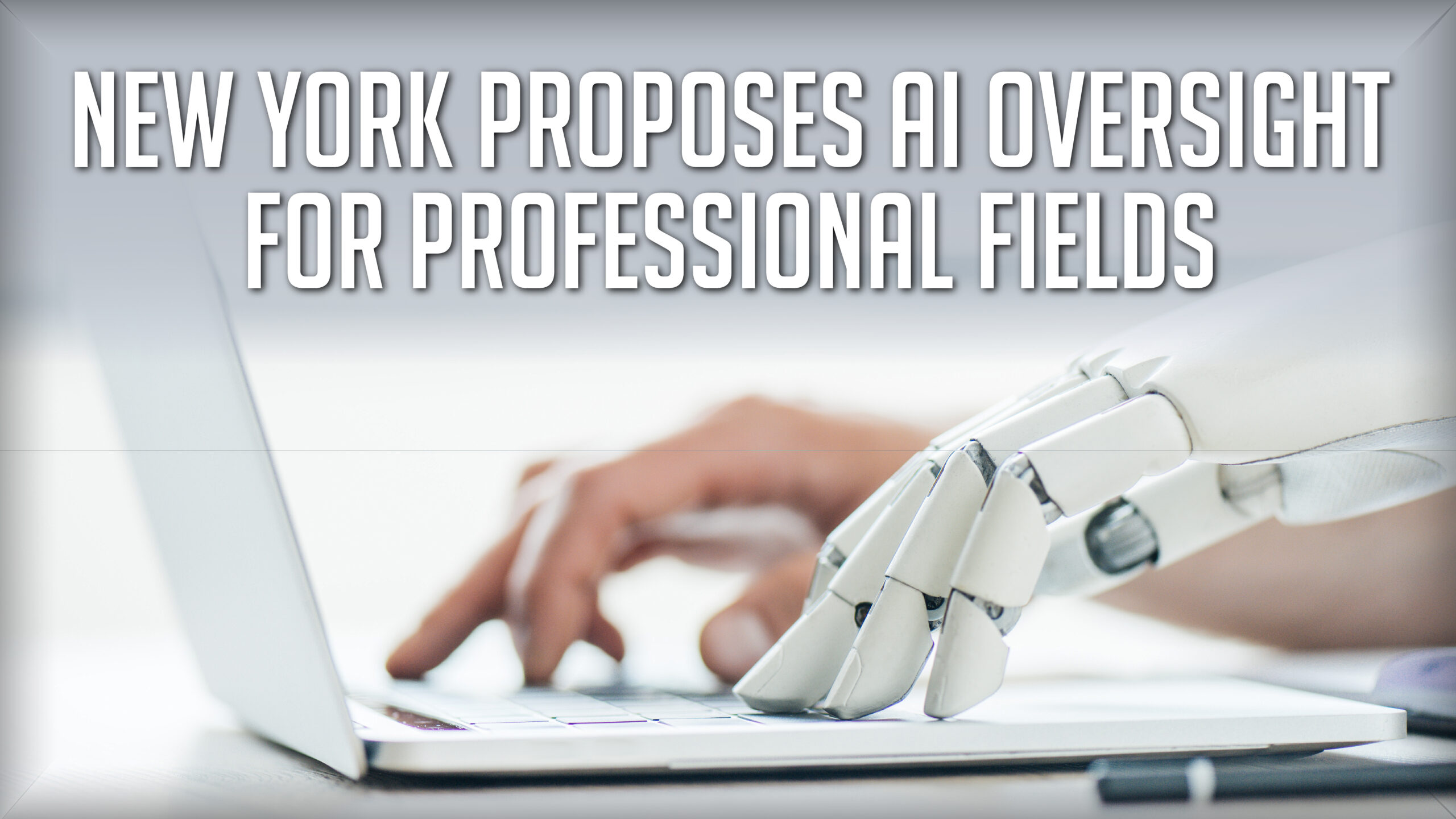
November 10, 2025
New York lawmakers introduced Assembly Bill A9219 (“Bill A9219” or the “Bill”) to ensure artificial intelligence (“AI”) used in regulated professions is developed and maintained under direct consultation with licensed experts. The bill would amend the General Business Law to add a new Article 47-A titled Artificial Intelligence in Professional Fields, authorizing the Attorney General to certify compliance and investigate violations. If enacted, the measure would make New York one of the first states to require professional licensing input in the creation of AI used in law, medicine, finance, and other regulated sectors.
The legislation defines “professional domain expert” as a credentialed individual with at least three (3) years of experience in a regulated field, such as a licensed attorney, certified public accountant, physician, or educator. Developers of AI tools used in those fields would need to demonstrate that such experts were directly and substantially involved in the technology’s design, data selection, validation, and post-deployment risk review. Developers must file documentation with the New York Attorney General confirming expert participation, qualifications, and any known risks. Violations could result in penalties of up to $50,000 per incident, injunctive relief, and public disclosure of non-compliance. Enforcement authorities would ultimately rest exclusively with the Attorney General because they would be empowered to issue certificates of compliance to developers meeting the law’s requirements.
The bill aligns with growing state and federal emphasis on responsible AI use which includes the National Institute of Standards and Technology’s AI Risk Management Framework and ISO/IEC 42001 standards. Its inclusion of a “red-teaming” safe harbor encourages developers to identify and cure potential compliance issues within 60 days. The measure’s effective date would be one year after enactment, allowing time for developers and professional firms to adapt internal review processes before enforcement begins.
Bill A9219 arrives amid national attention to the boundaries of AI in regulated advice. Perhaps motivated by the proposition of the Bill, OpenAI, on October 29, 2025, amended its usage policies to state that ChatGPT cannot be used for “the provision of tailored advice that requires a license, such as legal or medical advice, without appropriate involvement by a licensed professional.” Predictably, social media platforms quickly flooded with theories and “deep dives” on what this update may entail. A recent Yahoo News report, for example, provides detailed hypotheticals of when and how ChatGPT can provide commentary moving forward while also reiterating that AI tools cannot substitute for licensed professional judgment. In a broader picture context, New York’s proposal reflects a legislative movement to clarify accountability where AI intersects with professions that carry fiduciary or ethical duties.
DISCLAIMER
This publication may constitute attorney advertising under the laws and rules of professional conduct of one or more states. The information provided in this publication is for general informational purposes only and does not constitute legal advice. The contents are not intended to be a substitute for professional legal advice, consultation, or representation. No attorney-client relationship is formed by reading or relying on this publication. Prior results do not guarantee a similar outcome. Readers should consult a qualified attorney for advice regarding their individual circumstances or any specific legal questions they may have.
If you have questions about this publication, please contact Adam Friedman, Ralph Vartolo or Michael DeRosa,
Friedman Vartolo LLP, 1325 Franklin Avenue, Suite 160, Garden City, NY 11530, Phone: (212) 471-5100 | Fax: (212) 471-5150.